Inspection stickers and selling a car in New York City
No. Nothing on the New York DMV's inspection pages asks a private seller to have a car inspected before selling it. The DMV places the inspection with the person who registers the car next: a sticker issued to you is not valid for the buyer, who receives a 10-day inspection extension at registration and must pass within it. So a current sticker is not something you hand over, and an expired or failed one is a price question, not a legal bar. For most 1996 and newer cars the emissions test is OBD II, and it costs more in the five boroughs than outside the metropolitan area.
Sources re-checked .
Short answer
The New York DMV's inspection pages put no inspection duty on a private seller. The buyer gets a 10-day inspection extension at registration, and a sticker issued to you is not valid for them. In the five boroughs most 1996 and newer cars take the OBD II test, capped at $27 plus a $10 safety fee. A failed or expired car can still be sold.
NY DMV: About New York State Inspections; NY DMV: Register and title a vehicle
What New York State inspects every year
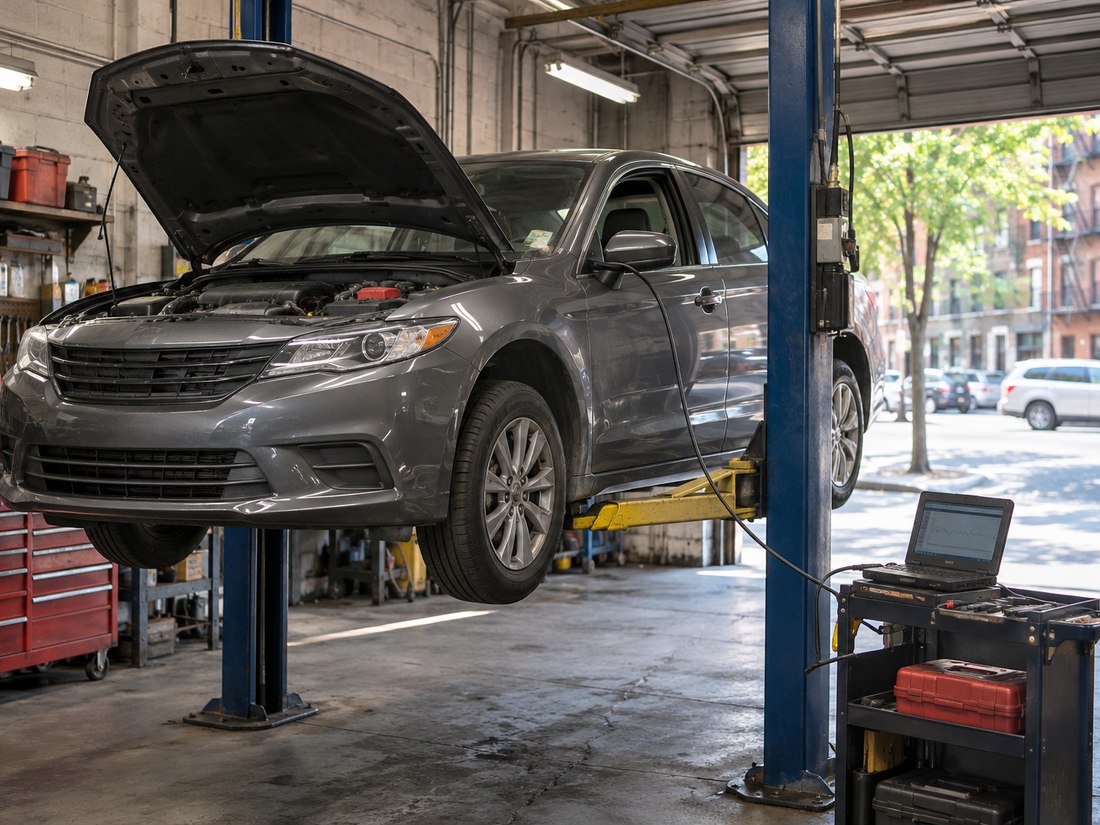
Every car registered in New York State is inspected once a year at an inspection station the DMV licenses, a station that displays the DMV's official sign. The DMV's inspections page puts it in one line: "All vehicles registered in New York State must get a safety inspection once a year at a DMV-licensed inspection station." The emissions inspection is done at the same time, so for most cars one visit covers both.
The sticker expires on the last day of the month punched on it. As of the DMV's page on November 7, 2026, a sticker expired for 60 days or less can bring a fine of $25 to $50; past 60 days, or with no sticker at all, $50 to $100, plus a mandatory state surcharge of $88 ($93 in town and village courts). In New York City the larger exposure is the parked car: the same page says a parked vehicle with no sticker or an expired one can receive a parking ticket, which matters for a car kept on the street while you find a buyer.
Source: NY DMV: Inspections; NY DMV: About New York State Inspections; NY DMV: Vehicle Safety/Emissions Inspection Program.
The seller's sticker does not travel with the car
The DMV's register-and-title page states it flatly: "An inspection issued to the previous registrant is not valid." Its About New York State Inspections page repeats the sentence under vehicles purchased from a private seller, and its program page says the same from the other side: when the vehicle is registered in a different name, the new registrant must have it inspected.
The documents the DMV hands over or mails at registration include a 10-day inspection extension sticker; the extension runs 10 days from the date of registration, and the car must pass before it runs out. Registration-Based Enforcement closes the loop: the DMV will not renew a registration unless it holds a computer record of a passed emissions inspection in the last 12 months or the registrant shows proof of one, and its enforcement page notes that safety and emissions inspections are also required whenever the ownership of the vehicle changes.
Source: NY DMV: Register and title a vehicle; NY DMV: About New York State Inspections; NY DMV: Vehicle Safety/Emissions Inspection Program; NY DMV: Registration-Based Enforcement of Inspections.
What the seller has to do about inspection in a private sale
Nothing on the DMV's inspection pages asks a private seller in New York State to inspect the car before handing it over. The inspection step sits on the buyer's side of the counter: the register-and-title page lists it as Step 4, after the registration itself. The one sale the DMV treats differently is a dealer sale, where the dealer must have the vehicle inspected within 30 days of the date of sale and before delivery.
Your side of a New York City sale is the title assignment, the bill of sale, the sales tax statement and the plates, covered on the paperwork page and plate surrender. On inspection, tell the buyer the month punched on the sticker and whether the car passed its last test; they have 10 days from registration to get a new one and will likely price any repair into what they pay you.
Source: NY DMV: Register and title a vehicle; NY DMV: About New York State Inspections.
Emissions testing in the five boroughs: OBD II and who is exempt
The DMV's program page states that most 1996 or newer gasoline vehicles and most 1997 or newer diesel vehicles with a gross vehicle weight rating under 8,501 pounds take the OBD II test. It examines the Malfunction Indicator Lamp, the check engine light, for operation and illumination, and verifies the results stored by the car's own emissions diagnostics. If that light is on, the DMV's advice is to have the fault repaired before the test. The inspection also confirms the presence and connection of the required emissions control devices, gas cap included, and examines the catalytic converter if the car was built with one; a car with a stolen converter is covered on car condition.
The DMV lists the vehicles exempt from the emissions inspection: motorcycles, vehicles less than two model years old, vehicles more than 25 model years old, electric vehicles, vehicles issued historical plates, vehicles subject to the heavy vehicle safety inspection, and diesels other than 1997 and newer diesels under 8,501 pounds GVWR. Older gasoline cars that are not exempt take a Low Enhanced inspection instead. The New York Metropolitan Area, which the DMV defines as the five counties of New York City plus Nassau, Suffolk, Rockland and Westchester, matters in two places: heavier diesels registered there take a smoke opacity test, and the OBD II fee is higher at stations inside it. The DMV also says a vehicle that fails emissions may not be able to be registered or, if already registered, may not have its registration renewed.
Source: NY DMV: Vehicle Safety/Emissions Inspection Program; NY DMV: About New York State Inspections.
Selling a car that failed or whose sticker has expired
You can sell it. An expired sticker is a ticket risk for whoever drives or parks the car, not a bar to signing over the title. In a private sale the buyer knows the car must pass within 10 days of registration, so the repair estimate comes off the price. Three DMV rules help if you decide to fix it first: you are not required to use the station that failed the car for the repair or the re-inspection, you may make the repairs yourself, and under the fee chart a car brought back within 30 days of the rejection is re-tested only on the portion it failed.
If you would rather not fix it, get the partner buyer's offer instead. Its page says that non-running cars and cars missing parts can still get an offer, and that the offer is free and carries no obligation. The online offer is the amount paid at pickup provided the car matches your description; the driver verifies the vehicle and completes the buyer's title paperwork, payment is a check handed over at pickup, and pickup and towing are free at a time that suits you. The whole sale usually takes a few days. A car not worth the repair is a junk car question; the offer steps are on how the offer works. Describe the failed test when you enter the car; the offer rests on the description matching at pickup.
Source: NY DMV: Vehicle Safety/Emissions Inspection Program; NY DMV: VS-77 Inspection Groups and Fee Chart (PDF); The buyer: selling and free pickup.
Finding a licensed station in New York City and what it costs
The DMV's facility lookup lists licensed stations by location and facility type, so you can search your own borough: choose public vehicle inspection stations as the type of business, then a county or a ZIP code. The results leave out dealer and fleet inspection stations. Licensed stations display a yellow and black sign reading Official Inspection Station. A station must inspect any vehicle it is licensed for when asked, or give you a written appointment within eight working days; any deposit cannot exceed the inspection fee.
The fee is capped by the DMV's Inspection Groups and Fee Chart, form VS-77 (revision 7/15, the chart on dmv.ny.gov as of November 7, 2026). Reading it takes the model year, fuel type and weight from the registration document, and the DMV's sample-registration page shows where each sits. For a Group 1 light vehicle (seating under fifteen, or a maximum gross weight under 10,001 pounds) the safety inspection maximum is $10. For 1996 and newer cars under 8,501 pounds GVWR the OBD II emissions maximum is $27 at a station inside the New York Metropolitan Area, which takes in all five boroughs, against $11 outside it; the Low Enhanced test for 1995 and older cars is $11. A station may charge less than the maximum but not more, may charge whether the car passes or fails, and may charge a re-inspection fee only if you take the car away and bring it back. The chart adds: "THERE IS NO SALES TAX ON INSPECTION FEES."
Source: NY DMV: About New York State Inspections; NY DMV: Sample registration documents; NY DMV: Vehicle Safety/Emissions Inspection Program; NY DMV: VS-77 Inspection Groups and Fee Chart (PDF).
Inspection questions New York City sellers ask
Do I need a new inspection before I sell my car in New York City?
No. The New York DMV places the inspection with the new registrant: the buyer receives a 10-day inspection extension at registration and must pass within it, and a sticker issued to you is not valid for them. No DMV inspection page asks a private seller to test the car first. NY DMV: About New York State Inspections
Can a car with an expired sticker sit on a New York City street while I sell it?
It can be ticketed there. The DMV says a parked vehicle with no inspection sticker, or with an expired one, can receive a parking ticket, and an expired sticker can bring a fine of $25 to $100 plus the state surcharge. Weigh that against how long the sale will take, or get an offer that includes pickup. NY DMV: About New York State Inspections
Where the sale goes from here
With inspection settled as the buyer's job, the seller's work is the title, the bill of sale and the plates on the paperwork page. If the car's sticker or check engine light is why you are selling, read how the offer works and then enter the car as it is; questions go to (332) 456-9629.
More on selling a car in New York City
- PaperworkThe Transfer by Owner block, the MV-912 bill of sale, the DTF-802 tax form, the odometer and damage boxes, and the twelve state DMV offices in the five boroughs.
- Plates & insuranceWhy the plates come off before a New York City sale, how to surrender them by mail or at a borough DMV office, the FS-6T receipt, and the per-day penalty if the insurance ends first.
- Title problemsA lost New York title, a lender on it, a late parent's car, mismatched names or no proof at all: the DMV form and fee for each, and what the buyer accepts.
- Any conditionSelling a New York City car that will not start, was flooded or lost its catalytic converter: what the buyer takes, who pays the tow, and the title disclosure the DMV requires.
- Junk carWhat to do with a junk car in New York City: the partner buyer's free pickup, a DMV-licensed dismantler and form MV-907A, or a 311 derelict report, with plates off first.
- Where to sellPrivate sale, dealer trade-in or instant offer in New York City: the 8.875% tax and $50 title fee a buyer pays the DMV, the trade-in tax rule, and repair-or-sell arithmetic.