Selling a salvage or rebuilt-title car in New York City: what the DMV requires
You can sell a salvage vehicle in New York City on the proof of ownership you hold; the New York DMV requires the seller of a rebuilt salvage vehicle to disclose its history, and a rebuilt one gets a New York title only after it passes the DMV's salvage examination. Two documents matter: the Salvage Certificate (MV-907A), which the DMV's definition ties to a vehicle an insurer acquired for significant damage, and the MV-83SAL, the mail-in examination application. Below: the DMV's definition, the examination fees and the two exam sites inside the city, the REBUILT SALVAGE: NY brand, the disclosure rule, and what the partner buyer publishes.
Sources re-checked .
Short answer
A New York car is salvage when an insurer acquires it with a Salvage Certificate (MV-907A) for significant damage, repairs pass 75% of its pre-damage value, it carries another state's salvage title, or the owner marks the wreck box on the title. You can sell it on that proof if you disclose the history; a rebuilt car needs the DMV's mail-in salvage examination ($200 or $205) before it gets a New York title.
New York DMV: Salvage Vehicles; New York DMV: Sell a Salvage Vehicle (Salvage Vehicle Disclosure)
When New York State calls a car salvage
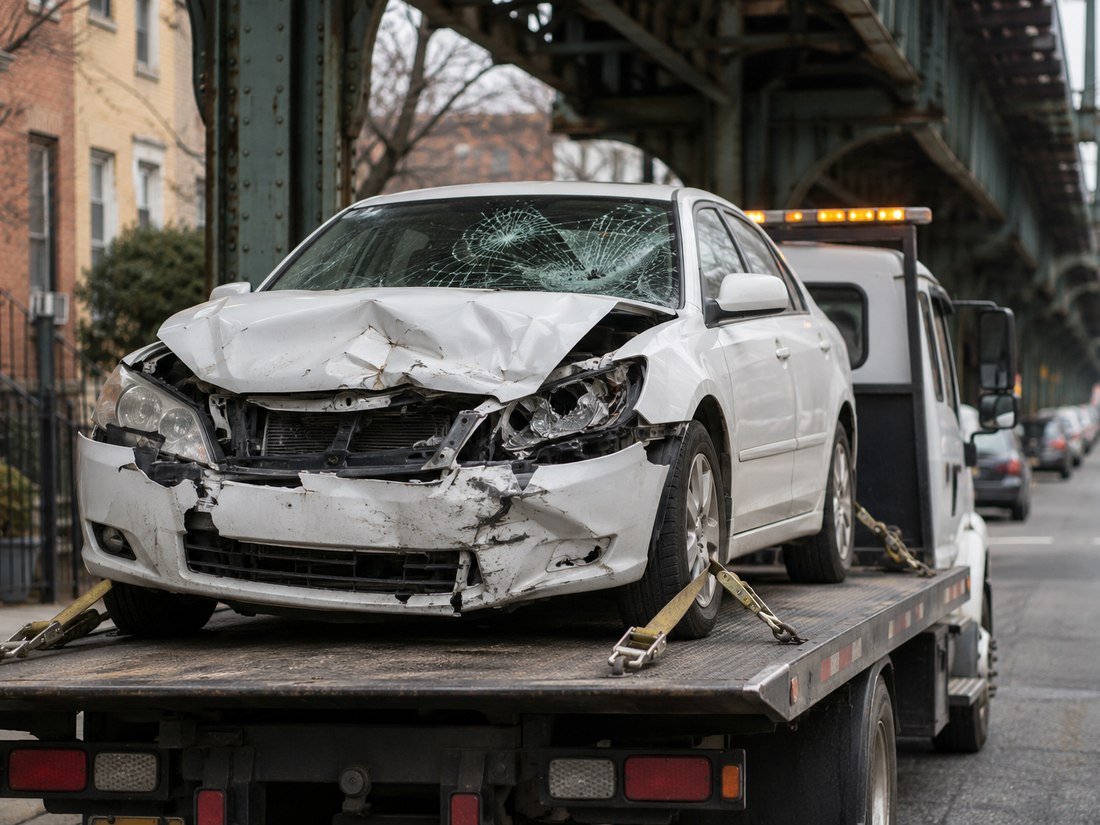
The New York DMV's salvage page defines a salvage vehicle as "a vehicle that was transferred to or acquired by an insurance company with a Salvage Certificate (MV-907A) because it has significant damage" from a collision, theft, vandalism or water. Three more routes sit in the same definition: repair costs above 75% of the pre-damage retail value, another state's salvage title brought into New York, and an owner declaring the car a wreck on the back of its New York State title at the time of sale or transfer.
That last route is the one a New York City seller controls. The back of a New York title carries a damage statement (when a title has none, the DMV's MV-103 Odometer and Damage Disclosure Statement carries it), and the DMV says the owner must mark the box next to it when the vehicle was destroyed or damaged to 75% or more of its retail value at the time of the damage. Failing to disclose damage can cost a fine of up to $2,000 plus Penal Law penalties. The paperwork page covers the rest of the transfer block.
Source: New York DMV: Salvage Vehicles; New York DMV: Buying a Salvage Vehicle.
After an insurer takes the car: what you hold and what the DMV will not touch
When an insurer acquires a damaged car, the DMV's definition says it moves to the insurer with the Salvage Certificate (MV-907A). The DMV's salvage pages offer no MV-907A to download; the only forms they list are the MV-83SAL and the MV-103. If you keep a salvage car yourself, the MV-83SAL (revised 10/25) prices Owner-retained Salvage as its own line, $200 as of that revision, the same as an MV-907A.
The DMV says it will not examine or issue a title for a rebuilt vehicle whose out-of-state title or MV-907A is labeled 'parts only', 'non-rebuildable', 'non-repairable', 'scrapped' or 'destroyed', because they are deemed not roadworthy. It also will not examine or title a rebuilt salvage vehicle with no title certificate or MV-907A proving ownership. Neither group can return to New York roads; the junk car page covers parts and scrap buyers.
Source: New York DMV: Salvage Vehicles; New York DMV: Buying a Salvage Vehicle; New York DMV: MV-83SAL Salvage Examination/Title Application (PDF).
The salvage examination: MV-83SAL, fees, the Bronx and Queens sites, the wait
The DMV's examination page states the rule: "If a salvage vehicle is rebuilt for use on roadways, the DMV must examine it before issuing a new title certificate or registration." It is a check for stolen vehicles and stolen parts; the DMV is explicit that it "is not a safety inspection, an emissions inspection, or an insurance examination."
The steps, in the order you do them (fees as of November 2026, from the examination page and the MV-83SAL revised 10/25):
- Decide how the car reaches the exam site: a tow, a flatbed, or a Temporary Transport Permit for driving it there. The permit is requested on the MV-83SAL itself, so get a New York safety inspection and New York insurance first; the form asks for the inspection report showing passed and proof of insurance (FS-20 or FS-21).
- Apply by mail only, on form MV-83SAL, with a check or money order payable to Commissioner of Motor Vehicles: $200 if your proof of ownership is a New York Salvage Certificate (MV-907A) or the car is owner-retained salvage, $205 if it is anything else, such as a New York or out-of-state title. The fee is not refunded and third-party or starter checks are not accepted. Include the original proof of ownership, any bill of sale or dealer reassignment, proof that sales tax was paid, any lien release, and proof of identity.
- Pick the site on the form. Queens Village serves New York, Queens, Kings and Richmond counties; the Bronx site serves Bronx and Westchester. The addresses are 2500 Waterbury Avenue, Bronx, NY 10462, (718) 613-3630, and 212-19 99th Avenue, Queens Village, NY 11429, (718) 468-0690. The DMV sends the appointment date by mail, or by email only if you gave an email address on the form.
- Finish every repair first. A deployed or removed airbag must be replaced with a new, model-specific one, never a used one. Keep original receipts for replaced parts; they must show the stock number and the VIN of the replacement item.
- Arrive on time: more than 30 minutes late and the DMV will not examine the car, and you pay another $150 and reschedule. You open the doors, hood and deck lid, describe the repairs and present the receipts; the exam takes about 30 minutes.
If it passes, "the DMV mails your title certificate in approximately 3 to 5 weeks, depending on volume." You then register it before driving it. The salvage page posts where the mail queue stands: as of November 6, 2026, the Junk and Salvage Unit was reviewing applications received by mail on or before October 26, 2026.
Source: New York DMV: The Salvage Vehicle Examination; New York DMV: Salvage Examination Facilities and Directions; New York DMV: MV-83SAL Salvage Examination/Title Application (PDF); New York DMV: Salvage Vehicles.
What REBUILT SALVAGE: NY on a title means
The examination page says a New York title issued after May 18, 1999 for a rebuilt salvage vehicle displays the brand REBUILT SALVAGE. The buying page adds the age rule: a title issued after the salvage process for a vehicle 8 model years old or newer displays REBUILT SALVAGE: NY, and titles for older vehicles are generally not branded. So a 15-year-old car that passed the exam may carry a clean-looking title and still have a salvage history; the disclosure rule below applies regardless of age.
For a buyer, the brand means the car was once salvage, was rebuilt, and passed the DMV's theft check; the MV-83SAL itself warns that the exam says nothing about safety. "If the DMV finds that a recently registered vehicle has a salvage history, the DMV will notify the customer that the vehicle must go through the salvage vehicle process." Until then the DMV will not issue a title or renew the registration.
Source: New York DMV: The Salvage Vehicle Examination; New York DMV: Buying a Salvage Vehicle; New York DMV: Salvage Vehicles; New York DMV: MV-83SAL Salvage Examination/Title Application (PDF).
Selling a salvage or rebuilt car: the disclosure New York requires
The DMV's seller page puts the rule in one sentence: "A person or dealer who sells a rebuilt salvage vehicle must provide the new owner with a disclosure statement regardless of the vehicle's age." The statement is on the back of New York State title certificates, so you complete it as part of signing the title over; when a title has no disclosure section, the DMV's MV-103 Odometer and Damage Disclosure Statement carries it. The penalty is the same as for the damage box: "If you fail to disclose the salvage history of a vehicle, you can pay a maximum fine of $2,000" plus Penal Law penalties.
Know what your buyer faces. If you sell on a title whose damage box is marked, the DMV office cannot complete the buyer's transaction; for a title only, the buyer pays sales tax at a DMV office, gets the FS-6T receipt, then mails the title, the MV-83SAL and a $205 check (as of the DMV's buying page, November 2026) to the Title Services Bureau. If your proof of ownership is an MV-907A, the buyer must complete the whole salvage examination before any title is issued. A New York dealer must receive the same disclosure on the title. The selling options page compares a private sale against an instant offer.
Source: New York DMV: Sell a Salvage Vehicle (Salvage Vehicle Disclosure); New York DMV: Buying a Salvage Vehicle.
Selling to the partner buyer: salvage, rebuilt and missing titles
The partner buyer publishes its position on title problems: "In many states, vehicles with salvage, rebuilt, or missing titles may still be eligible for sale." It names cars declared a total loss by an insurer as still eligible for an offer, and on a missing title its help center says that many of its buyers take cars without one. The title problems page covers lost titles, liens and a deceased owner.
Describe the damage the way the MV-83SAL itemizes it: which panels were hit, whether the frame was repaired or replaced, whether airbags deployed. Add whether the car runs and whether you hold a New York title, an MV-907A or an out-of-state salvage title. The offer is built from that description, and at pickup the driver checks the car against it before completing the buyer's title-transfer paperwork. The online offer is the amount paid at pickup provided the car matches what you described, so an undisclosed bent frame or missing converter is what puts it at risk. Pickup is free, at a time you choose, and payment is a check after the driver's inspection.
Source: The buyer: selling and free pickup; The buyer's help center: selling without a title.
Two questions NYC sellers ask about salvage titles
Can I sell my car on a Salvage Certificate (MV-907A) without the examination?
The New York DMV treats the MV-907A as a proof of ownership a buyer can hold: its buying page says that when the certificate is the proof of ownership, the buyer must complete the salvage vehicle examination before any title is issued. Expect buyers to treat the car as a project, or sell to one who takes salvage vehicles. Source: DMV, Buying a Salvage Vehicle.
Where in New York City is the salvage examination done?
At two DMV Division of Field Investigation sites: 2500 Waterbury Avenue in the Bronx and 212-19 99th Avenue in Queens Village. The MV-83SAL assigns Bronx and Westchester to the Bronx site and the other four boroughs to Queens Village; you pick the site on the form. Sources: DMV, Salvage Examination Facilities and the MV-83SAL (PDF).
Where to go from here
If you want to keep the car on the road, the examination above is the DMV's only route to a New York title for a rebuilt salvage vehicle. If you want it gone, read how the offer works, then enter the car's details and its title situation. For a car the DMV will not examine at all, start with the junk car page. Questions about a salvage title in New York City: call (332) 456-9629.
More on selling a car in New York City
- PaperworkThe Transfer by Owner block, the MV-912 bill of sale, the DTF-802 tax form, the odometer and damage boxes, and the twelve state DMV offices in the five boroughs.
- Plates & insuranceWhy the plates come off before a New York City sale, how to surrender them by mail or at a borough DMV office, the FS-6T receipt, and the per-day penalty if the insurance ends first.
- InspectionWhether a New York City seller needs an inspection before a sale (no), the buyer's 10-day extension, the OBD II test and fees in the five boroughs, and selling a car that failed.
- Title problemsA lost New York title, a lender on it, a late parent's car, mismatched names or no proof at all: the DMV form and fee for each, and what the buyer accepts.
- Any conditionSelling a New York City car that will not start, was flooded or lost its catalytic converter: what the buyer takes, who pays the tow, and the title disclosure the DMV requires.
- Junk carWhat to do with a junk car in New York City: the partner buyer's free pickup, a DMV-licensed dismantler and form MV-907A, or a 311 derelict report, with plates off first.