Getting rid of a junk car in New York City without a summons
A junk car in New York City leaves one of three ways: the partner buyer tows it away for free after an online offer, a New York State licensed dismantler or scrap processor takes it with the title, or, if it is not yours and it is sitting plateless on a public street, the city tags it after a 311 report and the Department of Sanitation handles derelicts. The two routes for your own car start the same way: the plates and the windshield sticker come off before the car moves. Below: the New York DMV rules and the city's own 311 wording, for all five boroughs.
Sources re-checked .
Short answer
A junk car in New York City can go to the partner buyer, who accepts non-running cars and tows for free after an online offer, or to a New York DMV licensed dismantler or scrap processor, who takes your title and files the state's salvage paperwork. A derelict that is not yours is reported to 311 and tagged by DSNY. Plates and the windshield sticker come off before the car moves.
New York DMV: junk and salvage businesses; NYC 311: abandoned vehicle
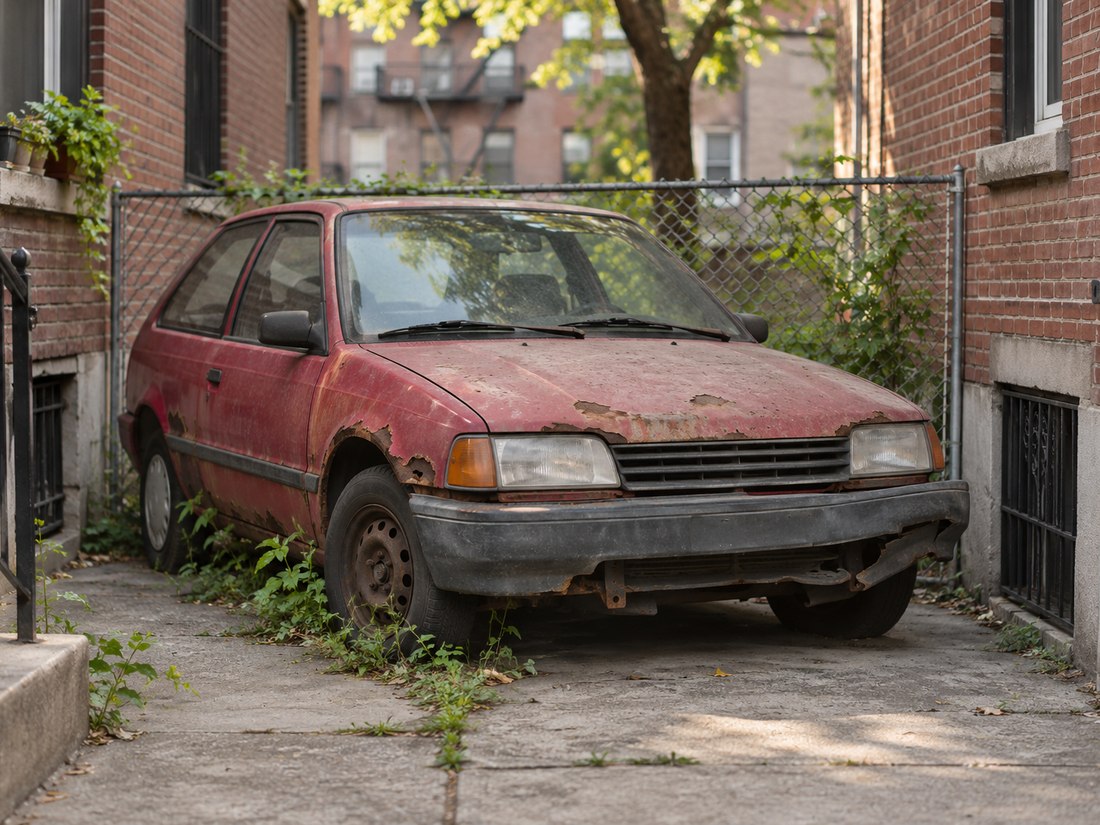
What makes a car a junk car in practice
In everyday use a junk car costs more to fix than it is worth: it will not start, it failed inspection, or it has sat under a tarp in a Queens driveway for a year. New York State has a narrower legal term. The New York DMV says a salvage vehicle is one an insurance company took with a Salvage Certificate (MV-907A) because of significant damage or because it "has repair costs that are more than 75% of the pre-damage retail value of the vehicle", one brought in on another state's salvage title, or one that "was declared a 'wreck' on the back of its New York State title by the owner at the time of sale or transfer." A worn-out car with a clean title and no insurer involved carries no such label; junk here is the everyday word.
Each of the three exits has its own section below. Leaving your own car on the curb is not one of them: 311 says "If you dispose of a vehicle improperly, you may get a summons with a fine of up to $1,000."
Source: New York DMV: salvage vehicles; NYC 311: vehicle disposal.
Route one: the partner buyer tows it from your block
For a car with a title, this route asks least of you: you describe the car online, non-running included, and the system prices it. The buyer's page states that cars that do not run or are missing parts can still get an offer, and that in many states vehicles with salvage, rebuilt or missing titles may still be eligible. The offer is free, there is no obligation, and you have a week to accept it. Searched for cash for junk cars in Brooklyn or Queens? Payment is a check handed over at pickup once the driver has looked the car over, not cash.
Pickup and towing are free, at a time you choose: pick a slot when the car is on the legal side of the street for alternate-side rules, or arrange access to the garage where it sits, and have the title ready. The driver verifies the car matches your description and completes the buyer's title-transfer paperwork; the online figure is the amount paid at pickup provided the car is as described. The sale usually takes a few days from offer to check. Steps: how the offer works; condition questions: selling in any condition.
Source: The buyer: selling and free pickup; The buyer: the week to accept and the check at pickup.
Route two: a New York State licensed dismantler or scrap processor
The New York DMV lists the businesses it treats as junk and salvage businesses: eight kinds, from vehicle dismantlers, salvage pools and itinerant vehicle collectors to scrap processors and repair shops that dispose of vehicle scrap. Their paperwork is the Salvage Certificate, form MV-907A, which the DMV issues to insurance companies, registered dismantlers and registered itinerant vehicle collectors, never to a private seller.
What you hand over is the title. The DMV's regulations say that a dismantler or collector that acquires a junk vehicle from you completes an MV-907A and must "submit the DMV copy to the Department of Motor Vehicles within 15 business days of the date such vehicle was acquired, together with the title certificate or other proof of ownership for such vehicle." From then on, "The transfer copy serves as the proof of ownership for the vehicle and may be used to transfer the vehicle." A scrap processor instead takes your title or MV-35 and sends it to the DMV within fifteen days. 311 puts it plainly: "The name of the auto wrecking firm should appear on the title as the new owner of the vehicle." Keep the receipt 311 describes: make and model, VIN, date and the wrecker's name.
No title? For an old car of little value, form MV-35 says "The vehicle being transferred must be worth $1250 or less and be at least eight model years old," it may go only to a registered dismantler, an itinerant vehicle collector or a certified scrap processor, and it warns in capitals "THE VEHICLE MAY NEVER BE TITLED AGAIN. IT MUST BE DISMANTLED OR SCRAPPED." It is for an owner who never titled the car or lost the title; $1,250 is the figure on the form's 6/22 revision. A car worth more than that needs a duplicate title first; see title problems.
Source: New York DMV: junk and salvage businesses; New York DMV: CR-81 regulations for junk and salvage businesses (PDF); New York DMV: form MV-35 (PDF); NYC 311: vehicle disposal.
Plates and the windshield sticker come off before the car moves
Whichever route you take, the plates do not go with the car. The New York DMV's order is firm: surrender the plates and registration first, cancel the liability insurance after. Its surrender instructions begin "Remove plates and stickers" and add "Destroy the registration and inspection stickers from your windshield." Frames and fasteners off too; the DMV will not accept plates with them attached.
Surrender them at a state-run DMV office in the five boroughs or by mail with form PD-7 (the postmark date counts; allow 21 days for the receipt), and keep the FS-6T receipt as proof. Cancel the insurance only after the plates are surrendered: the DMV says it will suspend the registration, and can suspend your license, if the plates are not turned in, and a lapse on an open registration brings a penalty. The mailing address, the penalty schedule and the insurance timing are on plates and insurance.
Source: New York DMV: surrender your plates and registration.
Route three: the city's derelict-vehicle route through 311
The city buys no junk cars (311 says it does not accept donated ones either), but the Department of Sanitation (DSNY) deals with derelicts on public property. 311 says "You can report a vehicle without license plates abandoned on a City street or sidewalk," and then: "If the abandoned vehicle meets the criteria to be classified as a derelict (i.e. junk) the Department of Sanitation (DSNY) will investigate and tag the vehicle within three business days." A plateless car that is not derelict is tagged and referred to the precinct instead.
A car with at least one plate is a police matter: 311 takes the report after 48 hours on public property, precinct officers respond between emergencies, and the owner is billed for towing and storage. Use this for the car rusting on your Bronx block, not for your own. 311 names no charge for reporting a derelict on public property; the fee it describes is for removing someone else's plateless car from your private property, by written request to DSNY with a signed waiver and a fee based on the price of scrap metal.
Source: NYC 311: abandoned vehicle; DSNY: derelict vehicles.
Which route fits: a decision rule for the five boroughs
Is the title in your name? If so, both paying routes are open. The partner buyer arranges the tow and covers its cost, whether the car sits in a Staten Island driveway or a Manhattan garage; with a dismantler, ask who moves the car. Without a title, the partner buyer's help pages say that many of its buyers take a car without one, and the state's MV-35 covers a car worth $1,250 or less that is at least eight model years old.
If the car is in an NYPD tow pound or under a Sheriff's boot, see towed or impounded first. If the car is not yours, do not touch it: the New York DMV tells anyone disposing of one to "contact your local police agency to verify that the vehicle has not been reported as stolen," and in New York City the report goes to 311. Whatever you choose: plates and sticker off, the title changes hands, the plates are surrendered and the FS-6T receipt kept, then the insurance ends.
Source: The buyer: selling a car without a title; New York DMV: abandoned and unclaimed vehicles; NYC 311: abandoned vehicle.
Junk car questions from New York City sellers
Can I junk a car in New York City without the title?
Yes, within limits. New York State form MV-35 lets the owner transfer a car worth $1,250 or less that is at least eight model years old to a registered dismantler, itinerant vehicle collector or certified scrap processor, with a copy of your ID attached, and the car can never be titled again. Form MV-35 (PDF) has the exact terms.
Will the city take my own junk car away for free?
311's derelict-vehicle route is for cars abandoned on public property, and it is handled by the Department of Sanitation after a report. Leaving your own car on the street to trigger it is improper disposal, which 311 says can bring a summons with a fine of up to $1,000. Read 311 on vehicle disposal and 311 on abandoned vehicles before you decide.
Take the plates off, then pick your exit
Whether the car goes to the partner buyer or a dismantler, start with plates and insurance, and if the title is the problem, go to title problems first. Questions about a specific car in the five boroughs: call (332) 456-9629.
More on selling a car in New York City
- PaperworkThe Transfer by Owner block, the MV-912 bill of sale, the DTF-802 tax form, the odometer and damage boxes, and the twelve state DMV offices in the five boroughs.
- Plates & insuranceWhy the plates come off before a New York City sale, how to surrender them by mail or at a borough DMV office, the FS-6T receipt, and the per-day penalty if the insurance ends first.
- InspectionWhether a New York City seller needs an inspection before a sale (no), the buyer's 10-day extension, the OBD II test and fees in the five boroughs, and selling a car that failed.
- Title problemsA lost New York title, a lender on it, a late parent's car, mismatched names or no proof at all: the DMV form and fee for each, and what the buyer accepts.
- Any conditionSelling a New York City car that will not start, was flooded or lost its catalytic converter: what the buyer takes, who pays the tow, and the title disclosure the DMV requires.
- Where to sellPrivate sale, dealer trade-in or instant offer in New York City: the 8.875% tax and $50 title fee a buyer pays the DMV, the trade-in tax rule, and repair-or-sell arithmetic.