Plates, the FS-6T Receipt and Insurance When You Sell a Car in New York City
Yes, you keep the plates: in New York State the plates and the windshield registration sticker come off before the buyer drives away, then you transfer the plates to another vehicle or surrender them to the DMV, and only after that do you cancel the insurance. The DMV issues a surrender receipt, form FS-6T, by mail or at the counter; keep it as your proof. New York publishes no seller's notice of sale: the DMV's own advice for preventing a problem when you sell is to remove the plates and surrender or transfer them. Below: the steps, the borough offices, the PD-7 mail route and the per-day lapse penalty.
Sources re-checked .
Short answer
You keep the plates. In New York State the plates and the windshield sticker come off before the buyer leaves; you then transfer the plates or surrender them to the DMV, by mail with form PD-7 (the postmark is your surrender date) or at a DMV office, and you cancel the insurance only after that. Keep the FS-6T receipt.
New York DMV: surrender your plates and registration; New York DMV: insurance lapses; New York DMV: pay an insurance lapse civil penalty
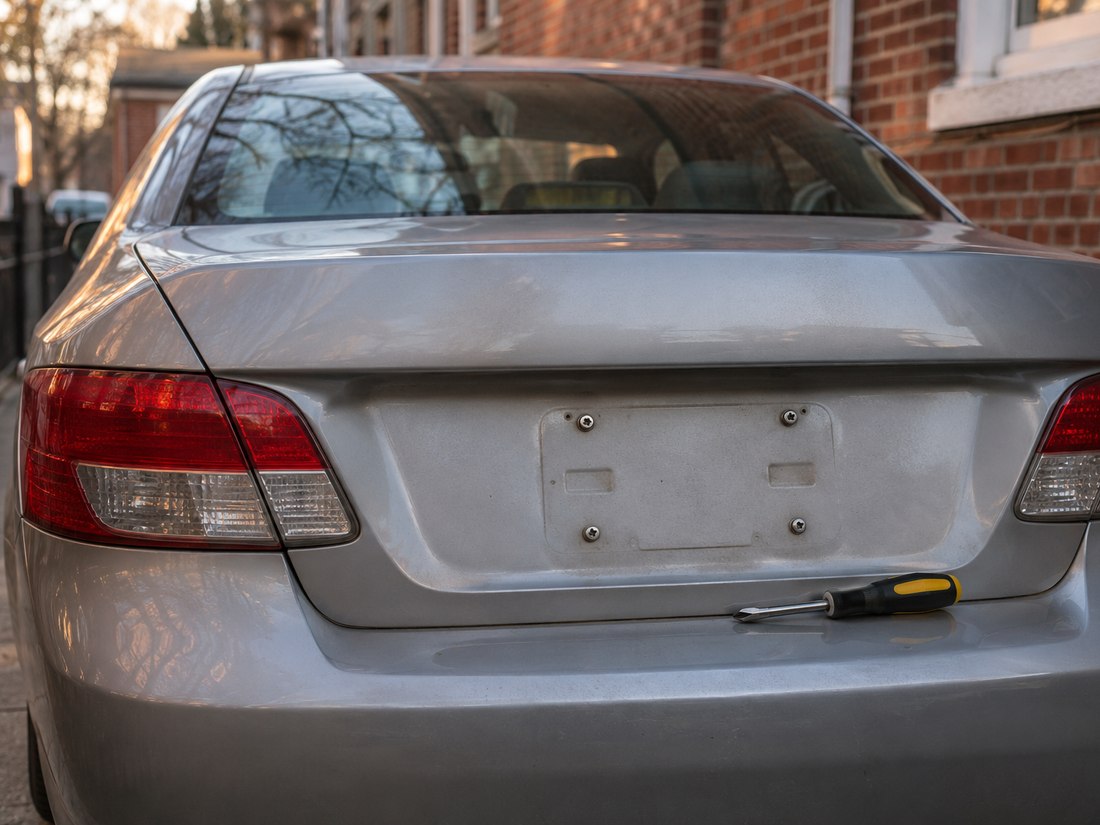
The order New York State sets: plates off, then surrender, then cancel
The New York DMV puts the plate step ahead of the sale and the insurance step last. Its insurance-lapse page says: "To prevent a problem when you sell a vehicle, remove the vehicle plates and the windshield registration sticker." The next sentence gives the two routes for the plates: surrender them to the DMV, or transfer them at once to another vehicle. The surrender page sets the insurance rule in one line: "Before you cancel the vehicle's liability insurance coverage you must surrender your plates and registration." Break that order and the DMV says it will suspend the registration and can suspend your driver license.
So on the day of a sale in New York City you take off both plates and the windshield stickers. The buyer takes the car without plates; the DMV says the new owner must register and title it at their local DMV office. Selling to the partner buyer changes none of this: the buyer's driver completes the buyer's title-transfer paperwork at pickup, while the plates and the insurance stay with the seller.
Source: New York DMV: insurance lapses; New York DMV: surrender your plates and registration; New York DMV: buy, sell or transfer vehicle ownership; The buyer: selling and free pickup.
Two ways to surrender: by mail with form PD-7, or at a DMV office
For either route, the DMV will not accept plates with frames or fasteners attached, so strip them bare, and destroy the registration and inspection stickers.
By mail. Fill in one Plate Surrender Application, form PD-7, for each set of plates: the plate number, the plate class, the three-letter code printed above the plate number on your registration document (the form's examples are PAS, COM, TRL and MOT) and the first three letters of the last name on the registration. Put the form and the plates in an envelope, not a box, and mail them to NYS DMV, 6 Empire State Plaza, Room B240, Albany, NY 12228. The form states there is no fee by mail. The DMV adds: "We use the mail postmark date as the date that you surrendered your plates." Allow 21 days for the FS-6T, and update your address with the DMV first if you have moved, because the receipt and any refund go to the address on the registration.
At a DMV office. Bring the plates and a completed PD-7, and keep the FS-6T you are given. The DMV says county motor vehicle offices charge a $1 fee to process a surrender; the offices inside New York City are state-run, covered below.
Surrendering early can return part of a two-year registration fee, never the plate fee, the title fee or the sales tax; the DMV's refund chart, the transfer credit and form MV-215 are on after you sell.
Source: New York DMV: surrender your plates and registration; Form PD-7, Plate Surrender Application (PDF); New York DMV: refunds and transfer credits for surrendered plates.
Where to surrender plates in the five boroughs
The DMV's surrender page says to bring the plates and PD-7 to a DMV office. Its office locator shows twelve state-run offices inside New York City as of 2026-11-07: four in Manhattan, two in the Bronx, two in Brooklyn, three in Queens and one on Staten Island, each taking reservations from its own details page. The street addresses are listed once on this site, under the state DMV offices in the five boroughs.
One caution from the locator's own data: the in-person service list it shows for those twelve offices names Register/Get Plates for My Vehicle but no Surrender Plates line; the two AAA offices it shows in Brooklyn and Manhattan do list Surrender Plates, for AAA members only. Open the office's details page before you go, or use the mail route, which costs nothing and fixes your date by postmark. The locator strongly encourages a reservation and warns that when an office has long wait times only people with a reservation are let in.
Source: New York DMV: office locations; New York DMV: office location data.
Keep the insurance until the plates are in: the lapse penalty
A lapse, in the New York DMV's definition, is any period when a vehicle registered in New York State has no liability coverage. Cancel the policy before the plates are in and the gap runs from the date the insurance ended to the surrender date (the postmark by mail), the date the DMV transfers the plates, or the date the registration expires.
What a lapse costs, as of 2026-11-07, from the DMV's civil penalty page: $8 per day for days 1 to 30, $10 per day for days 31 to 60 and $12 per day for days 61 to 90; the DMV's worked example puts a 90-day lapse at $900. You may pay and keep the plates only if the lapse is 90 days or less and you have not paid a lapse penalty in the past 36 months; otherwise you surrender the plates and serve a registration suspension equal to the lapse in days.
At 91 days or more no penalty is offered: the DMV says you must surrender the registration and plates, and it suspends your driver license for the same number of days as the registration, with a $50 termination fee to end the license suspension. The calculator on this page applies the schedule to your two dates.
Source: New York DMV: insurance lapses; New York DMV: pay an insurance lapse civil penalty; New York DMV: change, reinstate or cancel insurance coverage.
No seller's notice of sale in New York: what the DMV says protects you
The New York DMV's buy-sell-transfer page asks the seller for two things, proof of sale (the MV-912 bill of sale) and proof of ownership (the signed title), and lists no notice for the seller to send in afterwards. Its insurance-lapse page says what protects you instead: take off the plates and the sticker, then surrender or transfer the plates. The FS-6T is the record that you did.
If a lapse letter arrives anyway about a car you sold, the DMV's instruction is direct: "If you sell a vehicle and receive a letter from the DMV about an insurance lapse, bring the letter you received and proof that you sold the vehicle to a local DMV office." The proof is a bill of sale, a charity's letterhead statement for a donated car, or trade-in paperwork, showing the date of sale, both parties' names and addresses, and the year, make and VIN. Copies can instead go by mail, with the bottom part of the letter, to the Financial Security Bureau, New York State DMV, P.O. Box 2725 ESP, Albany, NY 12220-0725. Keep a copy of the MV-912 with the FS-6T; the forms are on the paperwork page.
Source: New York DMV: insurance lapses; New York DMV: buy, sell or transfer vehicle ownership.
Plates lost or stolen before you could surrender them
If the plates are lost, stolen or destroyed, the DMV's plates page says you must surrender the vehicle registration to the DMV instead. When both plates are gone, ask the police for a Report of Lost, Stolen or Confiscated Motor Vehicle Items, form MV-78B; the DMV says it comes only from law enforcement and is not on its website. If the police will not issue one, complete form MV-1441.3, Certification of Lost License, Permit or Plates, naming the agency you asked and the date. Bring the report and the registration to one of the offices above. The lapse page counts a report of lost or stolen plates as an event that ends a lapse, so file it promptly and keep the policy until you have.
Source: New York DMV: lost, stolen, destroyed or damaged plates; New York DMV: insurance lapses.
Plate and insurance questions from New York City sellers
Do I return the plates after selling a car in New York, or does the buyer keep them?
You keep them. The New York DMV tells sellers to remove the plates and the windshield sticker before the vehicle changes hands, then surrender the plates or transfer them to another vehicle. The buyer registers the car in their own name and gets plates at the DMV. Read the DMV's wording on insurance lapses.
Can I cancel my insurance the day I sell the car?
Not until the plates are surrendered or transferred. The DMV's rule is that you surrender the plates and registration before cancelling liability coverage. A lapse brings a civil penalty of $8, $10 or $12 a day by tier, as of 2026-11-07, or a registration suspension for the same number of days. See the DMV's civil penalty schedule.
What comes after the receipt
With the FS-6T in hand, cancel the policy and watch for the refund; the rest of the post-sale list, from E-ZPass to tickets dated after the sale, is on after you sell. Selling to the partner buyer? How the offer works covers pickup day, and a person answers at (332) 456-9629.
Count your lapse days and the DMV penalty
Enter the day your liability coverage ended and the day the plates reached the DMV (the postmark date if you mailed them, or the day you plan to). The tool counts the calendar days between them and applies the New York DMV's per-day schedule. The DMV's Suspension Order carries the official count and amount; use this to see what the dates imply before that letter arrives.
The cancellation date on the insurer's notice.
By mail, the postmark date. At an office, the date on the FS-6T.
Schedule and conditions: New York DMV, pay an insurance lapse civil penalty, read 2026-11-07. The 91-day rule, the license suspension and the $50 termination fee: New York DMV, insurance lapses, read the same day. The DMV may count the lapse differently from a calendar-day difference; its Suspension Order governs.
More on selling a car in New York City
- PaperworkThe Transfer by Owner block, the MV-912 bill of sale, the DTF-802 tax form, the odometer and damage boxes, and the twelve state DMV offices in the five boroughs.
- InspectionWhether a New York City seller needs an inspection before a sale (no), the buyer's 10-day extension, the OBD II test and fees in the five boroughs, and selling a car that failed.
- Title problemsA lost New York title, a lender on it, a late parent's car, mismatched names or no proof at all: the DMV form and fee for each, and what the buyer accepts.
- Any conditionSelling a New York City car that will not start, was flooded or lost its catalytic converter: what the buyer takes, who pays the tow, and the title disclosure the DMV requires.
- Junk carWhat to do with a junk car in New York City: the partner buyer's free pickup, a DMV-licensed dismantler and form MV-907A, or a 311 derelict report, with plates off first.
- Where to sellPrivate sale, dealer trade-in or instant offer in New York City: the 8.875% tax and $50 title fee a buyer pays the DMV, the trade-in tax rule, and repair-or-sell arithmetic.